
In agriculture, water is life. Yet in every field it behaves differently: It infiltrates more or less, is retained better or worse, and is distributed evenly… or not. In practice, this difference determines how much water actually reaches the roots and how much is lost through runoff, deep percolation, or evaporation.
Managing water with precision is essential both during drought periods and in situations of excess moisture. When soil does not absorb water properly, irrigation or rainfall can simply “pass through”: Water runs across the surface or is repeatedly lost in the same areas, leaving dry zones where plants cannot take advantage of it. During prolonged droughts, surface crusts may also form, making rehydration more difficult and reducing available moisture. For this reason, beyond simply “applying water,” the real challenge is ensuring that water enters the soil, is evenly distributed, and remains available in the root zone.
Why Water Does Not Behave the Same in All Soils
Water movement in soil largely depends on very specific physical properties that govern its behavior through:
- Infiltration: The soil’s capacity to allow water to enter.
- Retention: How long water can remain available before being lost to gravity or evaporation.
- Distribution: How water spreads throughout the soil profile and, above all, within the root zone.
If any of these three processes performs poorly, plants may have limited access to water even when, “on paper,” irrigation or rainfall has been sufficient. And when water availability is irregular, nutrient uptake is often affected as well: Water is the carrier, and if it does not reach the roots continuously, nutrition will also be inconsistent.
How It Works: Two Synergistic Actions (Infiltration + Distribution)
HydraGuard acts through two complementary mechanisms that reinforce each other:
1) Infiltration: Facilitating Water Entry, Even in Very Dry Soils
HydraGuard helps water penetrate dry soils by reducing surface tension and removing barriers that block infiltration and root contact. In completely dry soils, this initial “entry” of water is often the main bottleneck: If water does not enter properly, nothing else matters.
2) Distribution: Moving Water Uniformly Through the Soil Profile
Beyond entering the soil, water must also be evenly distributed. HydraGuard promotes uniform distribution throughout the soil profile, increasing effective availability and persistence of water in the root zone for a more consistent supply.
The Science Behind the Mechanism: Surface Tension and Soil Wettability
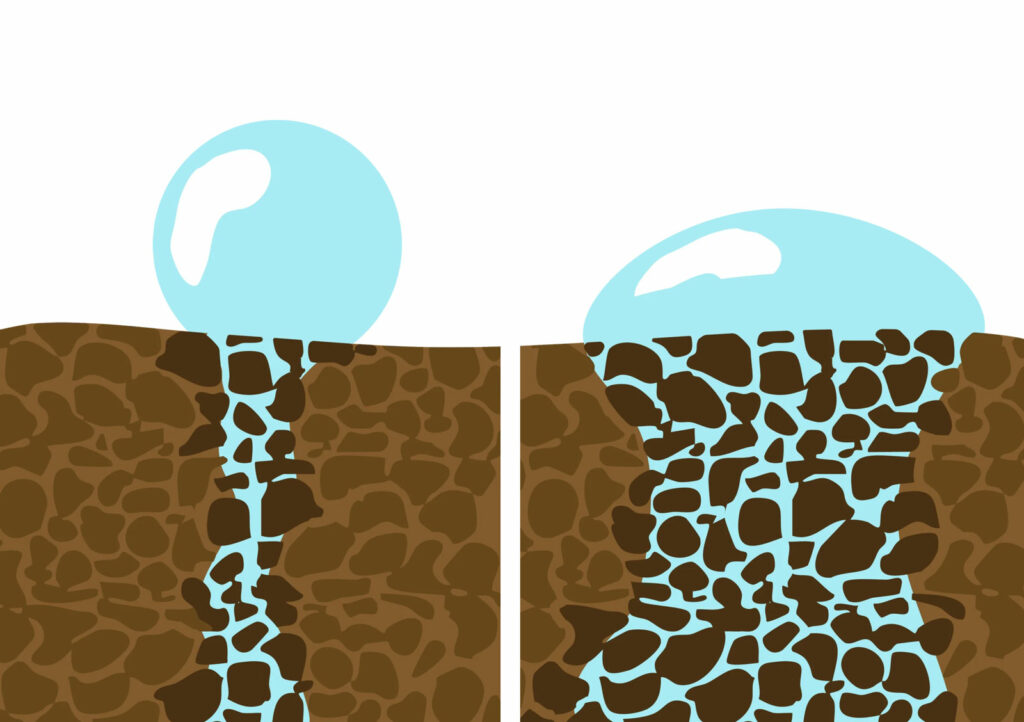
Reducing Surface Tension: From Isolated Droplets to a Continuous Wetting Film
One of the key factors is surface tension. When it is high, water tends to form isolated droplets. When it is reduced, water can spread as a thin film, increasing contact with soil particles.
HydraGuard reduces surface tension so that water spreads more effectively, accelerating infiltration and improving penetration. Lower surface tension also allows water to move further and more uniformly, creating a broader wetting front. In the field, this translates into faster rehydration in crusted, compacted, or very dry soils, where conventional irrigation is often ineffective.
Reducing Hydrophobicity: When Soil “Repels” Water
Another common issue is hydrophobicity: Soils that repel water due to organic coatings or repeated drying–rewetting cycles. This is frequent in sandy soils, substrates with high organic matter content, or areas exposed to strong alternations between wet and dry conditions.
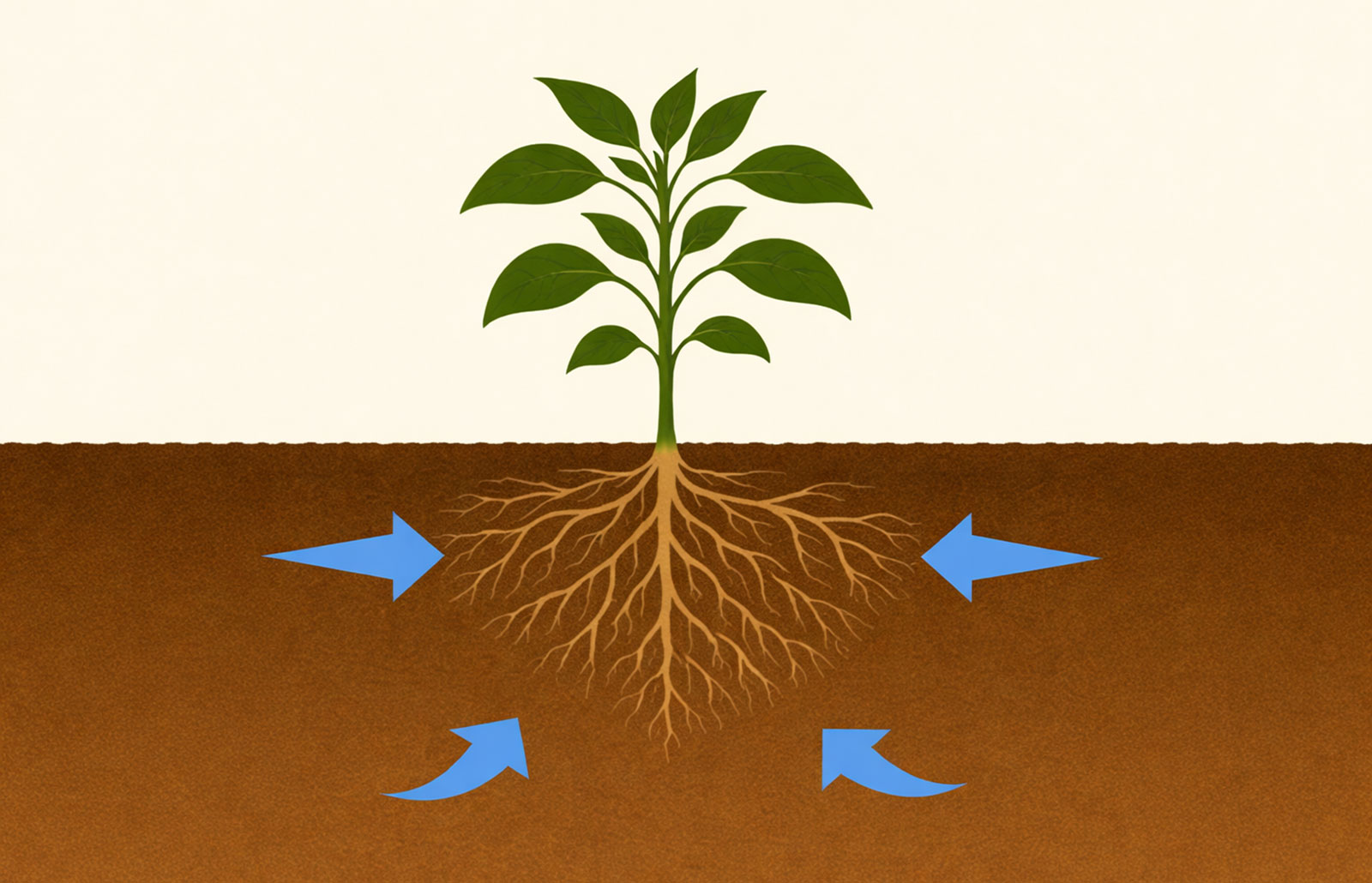
Here, poloxamers play a key role. These molecules coat soil particles and link together, forming chains throughout the soil matrix. These chains allow water to move through the soil aggregates, preventing the formation of dry zones. When roots absorb water and dry the surrounding soil, the area is rapidly rehydrated through the poloxamer chains, enabling a continuous flow of water toward the roots.
Agronomic Benefits: What Changes When Water Enters and Distributes More Effectively
With HydraGuard, water infiltrates and distributes more homogeneously, increasing soil water storage and availability to roots. HydraGuard promotes:
- Improved water penetration, even under dry or compacted conditions.
- Greater infiltration and, consequently, reduced runoff risk.
- Water remaining available to the plant for longer periods in the soil.
- Support for a more stable crop water balance by connecting the soil matrix and facilitating continuous water flow.
- Improved water-use efficiency and support for nutrient uptake by maintaining consistent availability to the roots.
Field Evidence: Observed Results
With solutions of this type, the key question is always the same: What changes can be measured in the field?
1) Faster Infiltration in Rice
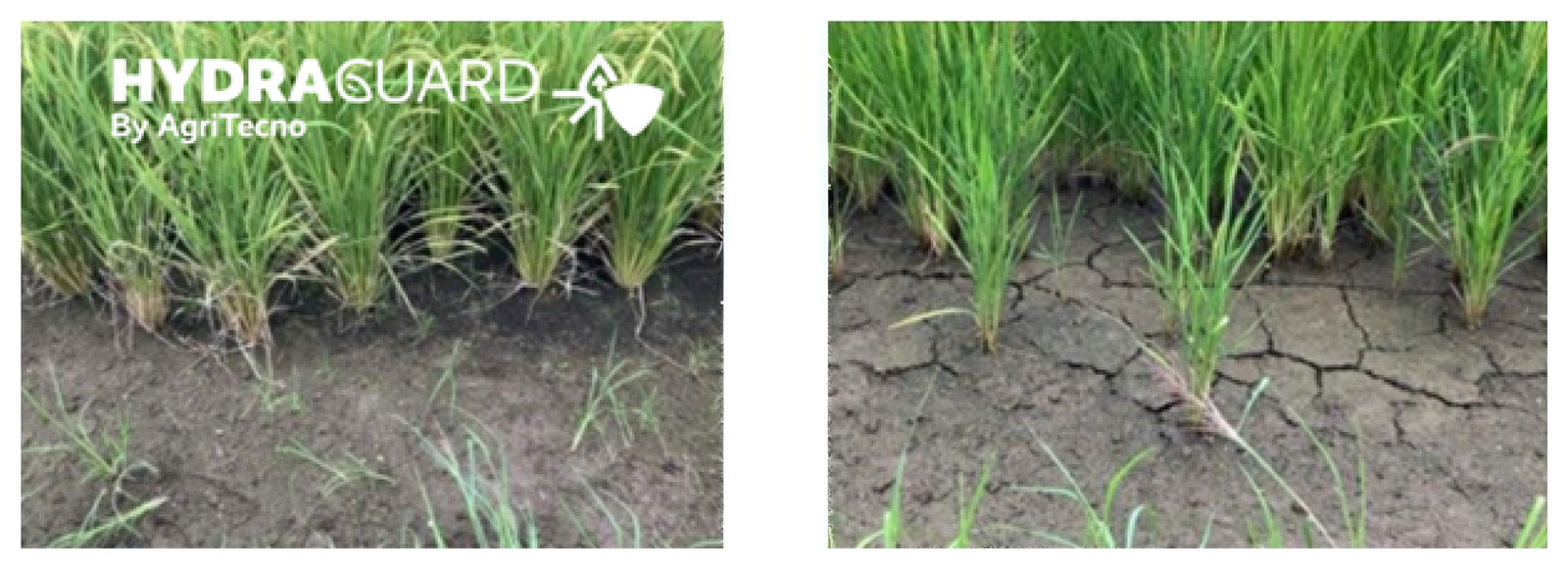
This image, taken in a rice field, shows how HydraGuard retains water within the soil, preventing losses through evaporation or percolation. In the image on the right, where HydraGuard was not applied, soil cracking due to rapid water loss is clearly visible. In contrast, the image on the left shows soil remaining moist and free from cracking symptoms.
2) Yield and Efficiency With Reduced Irrigation
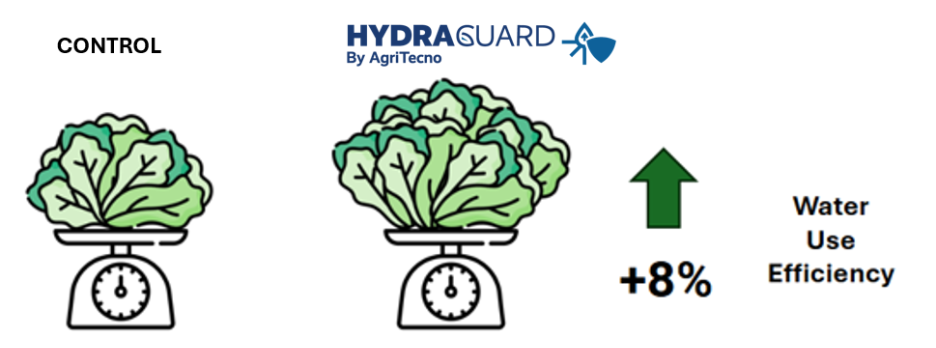
HydraGuard allows water to be used more efficiently. Trials conducted under controlled conditions on lettuce under water-deficit stress show that water-use efficiency with HydraGuard is 8% higher than the control. In other words, for each cubic hectometer of water applied, yield increases by 8% compared to the control, thanks to HydraGuard’s action.
Effective Even Under the Most Challenging Conditions
HydraGuard is effective in addressing common soil-related challenges affecting water availability. Its ability to improve crop water conditions is evident even in the most adverse situations:
- Soils with surface crusting or difficult rewetting after dry periods.
- Hydrophobic soils (water repellency) or soils subject to repeated drying–rewetting cycles.
- Situations where avoiding runoff and improving water entry is critical.
- Management systems where a more uniform water supply in the root zone is required.
Water Efficiency You Can See in the Field
Water efficiency does not begin at the emitter nor end with the irrigation controller. It begins in the soil: In whether water enters, spreads, and remains available where the plant needs it.
HydraGuard is based on a physical approach, surface tension, hydrophobicity, infiltration, distribution, and persistence, to improve soil water dynamics and convert water input into real availability for roots, increasing irrigation efficiency and, consequently, crop yield.