
The challenge of heat stress in soybean
Heat stress (HS) and water stress (WS) events severely affect soybean productivity, especially when they occur during the reproductive and grain-filling stages.
During the crop’s critical period (between growth stages R3 and R6), sustained high temperatures reduce grain number (GN) and, consequently, final yield.
These effects are driven by physiological and biochemical alterations that decrease the crop’s photosynthetic capacity and metabolic efficiency.
In this context, the application of AgriTecno foliar biostimulants emerges as an effective tool to mitigate the impact of extreme heat, helping to maintain physiological functionality and improve productivity under adverse abiotic stress conditions.
Study objective
To evaluate the ability of different AgriTecno foliar biostimulant treatments to mitigate the negative effects of heat stress during the soybean reproductive period under rainfed conditions, by assessing key physiological and agronomic variables.
Experimental design
The trial was conducted in Argentina through a collaboration between INTA-CONICET and AgriTecno, using a field-based experimental approach designed to reproduce heat stress conditions and compare them with control plots.
Treatments evaluated
| Treatment | Abbreviation | Dose | Application timing |
| AgriTecno Product A Priming | APri | 3 L/ha | 48 h before stress onset |
| AgriTecno Product A Buffering | ABuf | 3 L/ha | Same day as stress onset |
| AgriTecno Product A Recovery | ARec | 3 L/ha | Same day as stress end |
| AgriTecno Product B Priming | BPri | 3 L/ha | 48 h before stress onset |
| AgriTecno Product B Buffering | BBuf | 3 L/ha | Same day as stress onset |
| AgriTecno Product B Recovery | BRec | 3 L/ha | Same day as stress end |
| Stressed control | CEst | – | – |
| Non-stressed control | CSEst | – | – |
Heat stress was initiated at phenological stage R4 (full pod development) and maintained for 10 days using mobile shelters covered with transparent polyethylene. The shelters were open at the base to ensure atmospheric gas exchange.
The temperature inside the shelters increased by approximately +8°C compared to the control, while nighttime conditions remained similar, ensuring that stress was correctly induced without altering nocturnal temperatures.
Canopy temperature measurement
Canopy temperature (CT) was used as an indicator of soybean plant physiological status to assess the impact of high-temperature stress and the effectiveness of AgriTecno foliar biostimulants.
Measurements were taken at three key moments: before, during, and after heat stress.
CT is considered an integrative variable reflecting multiple physiological responses (stomatal conductance, respiration rate, plant water status, and photosynthetic efficiency), making it a reliable parameter for comparing treatment performance under heat stress conditions.
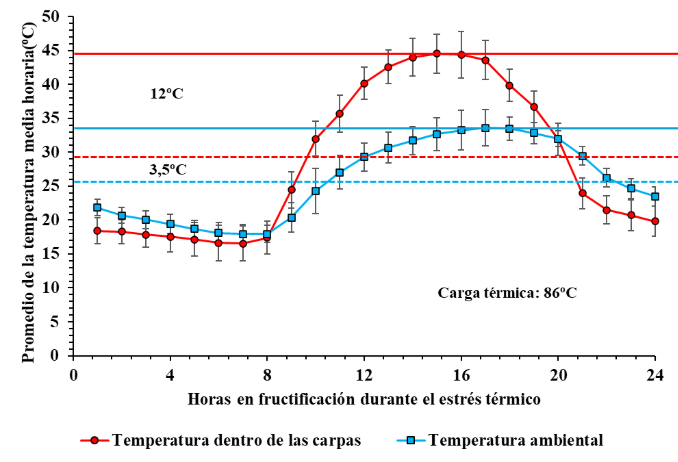
The evolution of average hourly air temperature during the heat treatment is presented, comparing ambient control plots and heat-stressed plots during the reproductive period.
The graph shows that temperature inside the shelters increased by an average of 8°C compared to ambient conditions during the central hours of the day, but not at night, confirming correct stress induction without affecting nocturnal conditions.
Results: Reduced heat stress and improved physiological performance
Foliar treatments with AgriTecno biostimulants resulted in an average 3 °C reduction in canopy temperature compared to the untreated stressed control.
This indicates an improved cooling capacity of leaves exposed to heat stress when treated with foliar biostimulants and suggests enhanced plant water relations. The application of these biostimulants was associated with reduced disruption of key physiological processes such as transpiration and water balance, highlighting the protective effect of the formulations.
No significant differences were observed between Products A and B, nor between application timings (priming, buffering, or recovery), demonstrating the versatility and consistency of the biostimulant effect.
Canopy temperature under heat stress
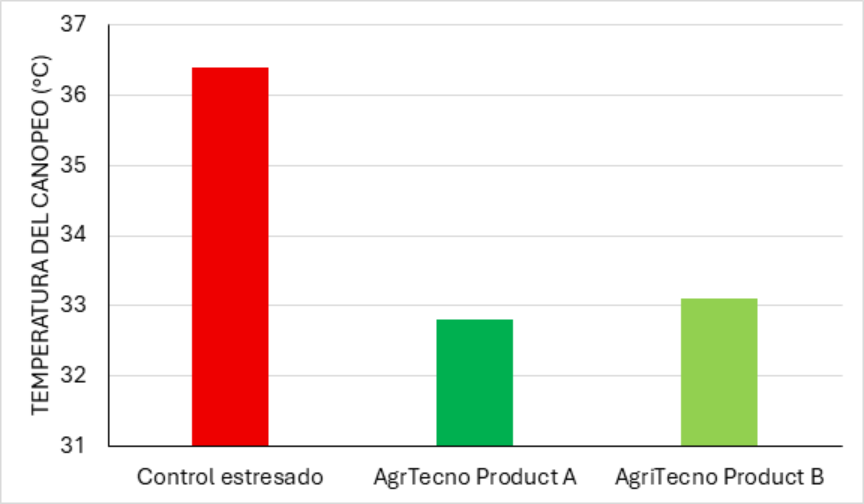
Interpretation:
The green bars corresponding to AgriTecno foliar biostimulant treatments show an average reduction of 3°C in canopy temperature compared to the stressed control, indicating improved thermal regulation and greater physiological stability under stress conditions.
Impact on crop yield
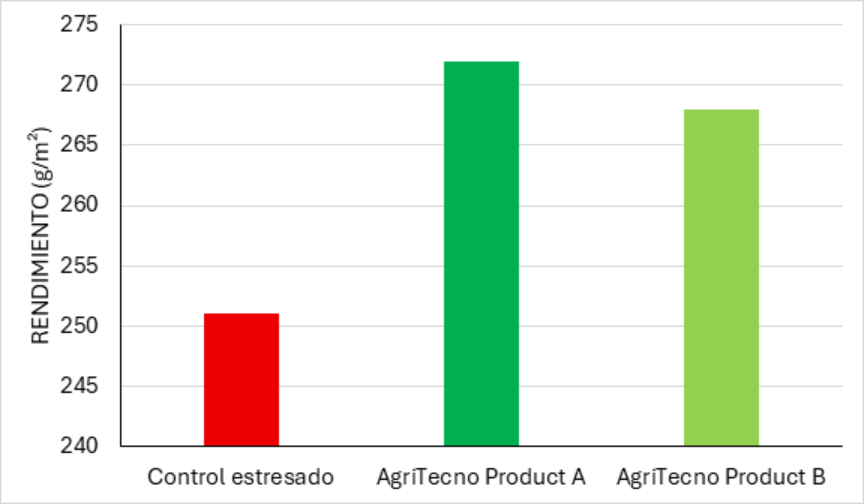
As a result of improved physiological protection, soybean yield in plots treated with AgriTecno biostimulants was significantly higher than in the stressed control, exceeding 8%, and showed no significant differences compared to the non-stressed control.
All application strategies, preventive, buffering, and recovery, demonstrated consistent effectiveness in maximising yield, confirming that the biostimulant effect is maintained regardless of the stress management strategy applied.
Conclusions
AgriTecno foliar biostimulants demonstrated proven effectiveness under field conditions against heat stress in soybean.
- A 3°C reduction in canopy temperature reflects an improved physiological response of the crop under abiotic stress conditions.
- Both formulations delivered consistent results, achieving more than 8% yield increase compared to the stressed control and maintaining yield under extreme conditions.
- Flexibility in application timing provides growers with an efficient and adaptable tool to face adverse climatic scenarios.
Want to learn more about our biostimulant solutions?
At AgriTecno, we develop science- and biotechnology-based products that strengthen crop physiology under stress conditions.
Discover our foliar biostimulants and learn how to maximise yield even under high-temperature stress.