
Biostimulants and Nutrient Use Efficiency (NUE)
Introduction
In an increasingly demanding agricultural context, farm viability depends on maximizing yields and optimizing every unit of input applied. In modern agriculture, fertilizers are essential to achieve this goal.
Nutrient use efficiency (NUE) refers to the rate at which nutrients applied to the agroecosystem are utilized, particularly nitrogen, phosphorus, and potassium.
This need is even more evident in the current market context. As a recent reference, granular urea increased by 20.36% over the past month (FOB U.S. Gulf). Price pressure is occurring in a tight market that complicates the global supply of fertilizers and associated raw materials.
In this scenario, nutrient use efficiency (NUE) becomes a strategic factor. It is not only about applying nutrients, but about ensuring that crops absorb, assimilate, and efficiently convert them into biomass and yield.
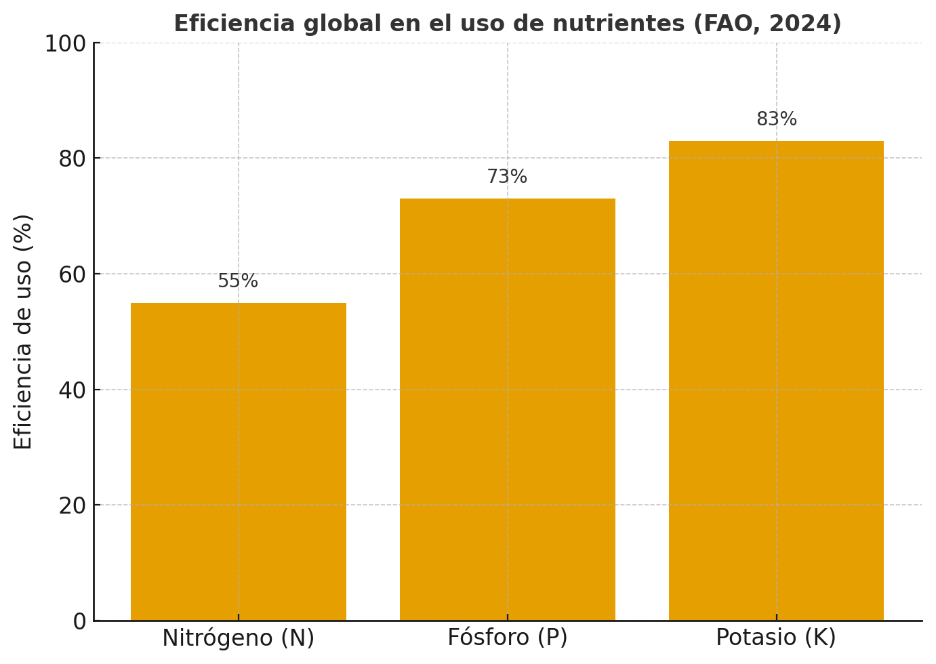
Global nitrogen, phosphorus, and potassium efficiency data — sourced from the FAO-IFA Cropland Nutrient Budget Database (2021). Values shown represent global averages; however, significant variability exists across regions and production systems.
What is NUE?
NUE is defined as the ratio between the production obtained or the amount of nutrient assimilated and the amount applied.

This indicator allows evaluation of how efficiently an agricultural system converts nutrients into biomass or economic yield.
Factors Affecting NUE
Several factors influence nutrient use efficiency, including:
- Soil: texture, organic matter content, and pH.
- Agronomic management: application timing, type of fertilization, synchronization with the crop cycle.
- Irrigation and climate: progressive nutrient supply under irrigation favors higher uptake.
- Plant physiological and metabolic capacity: NUE also depends on the plant’s ability to absorb, assimilate, and transform nitrogen into biomass and yield.
- Stress conditions: limit nutrient absorption and assimilation.
Objective: Increasing NUE
Fertilization can represent between 10% and 35% of production costs depending on the crop. In a context of high volatility, this economic pressure increases further, requiring strategies that enable higher yields with more efficient nutrient use.
Improving NUE allows:
- Achieving higher biomass and yield with the same fertilization input.
- Maintaining profitability even with reduced nutrient application.
- Complying with agri-environmental regulations that limit fertilization rates.
Improving nutritional efficiency means acting not only on nutrient availability in the system, but also on the plant’s ability to use nutrients effectively.
How Biostimulants Improve NUE
Biostimulants act on different physiological and biochemical pathways related to nutrient uptake, assimilation, and utilization. Among their most relevant effects:
- Stimulation of chlorophyll and protein synthesis, enhancing photosynthesis and nitrogen assimilation.
- Increased enzymatic activity, especially key enzymes such as nitrate reductase and glutamine synthetase.
- Improved uptake of N, P, and micronutrients even under stress conditions.
Studies show that L-amino acid-based biostimulants increase biomass, accumulation of nitrogen compounds, and total organic nitrogen content, significantly improving NUE parameters.
NUE and AgriTecno Biostimulants
AgriTecno formulations, validated under controlled and field conditions, show consistent results.
Experimental design
- T1: N-100% (8 mM)
- T2: N-100% + AgriTecno biostimulant
- T3: N-50% (4 mM)
- T4: N-50% + AgriTecno biostimulant
The study evaluates the response of the AgriTecno biostimulant in plants grown under two nitrogen fertilization levels: N-100% (8 mM) and N-50% (4 mM), comparing treated and untreated plants.
Main Results: Impact of the Biostimulant on Nitrogen Efficiency
To accurately determine the processes influenced by the application of AgriTecno’s biostimulant, different stages of nitrogen movement within the plant were analyzed.
Nitrogen Uptake
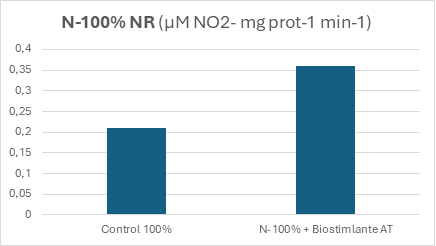
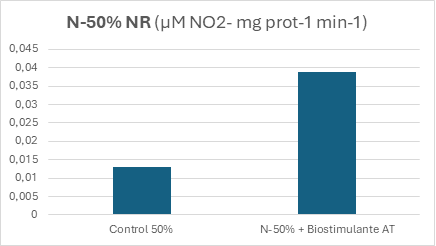
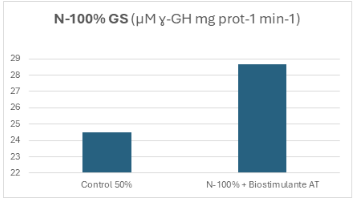
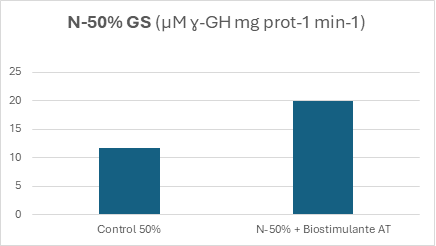
Treated plants showed an increase in the concentration of key enzymes in the GS/GOGAT cycle, essential for nitrogen transformation and assimilation:
- Nitrate reductase (NR): +71% under optimal fertilization (N-100%) and +200% under limiting conditions (N-50%).
- Glutamine synthetase (GS): +17% in N-100% and +71% in N-50%.
These results indicate a clear improvement in the plant’s metabolic capacity to incorporate absorbed nitrogen into functional organic compounds.
Photosynthesis
The biostimulant was associated with improvements in photosynthesis and in physiological processes related to chlorophyll synthesis and photosynthetic activity.
Under optimal fertilization conditions, the application of the biostimulant increased the photosynthetic rate (A) by +75% compared to the control.
Under limited fertilization, the increase was +29% compared to the control under the same conditions.
Results by Nutritional Condition
- N-100% + AgriTecno biostimulant: +75%
- N-50% + AgriTecno biostimulant: +29%
This improvement in photosynthesis is particularly relevant because it links nitrogen nutrition with the plant’s actual capacity to generate photoassimilates and sustain growth.
Photoassimilate Synthesis
The combined effect on uptake and photosynthesis enabled the plant to generate higher amounts of essential compounds.
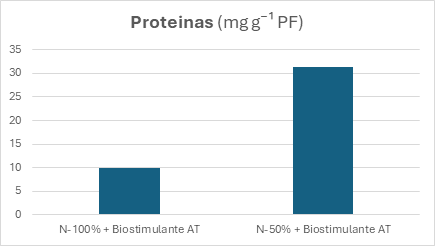
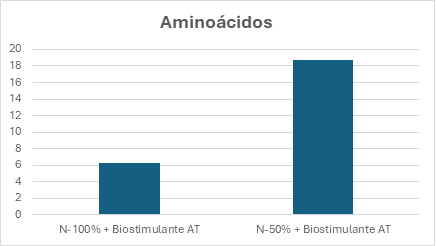
These results show that improved physiological efficiency in nitrogen use can translate into a tangible agronomic response, even under limited nutrient availability.
Particularly noteworthy is that, even with half the nitrogen fertilization (N-50%), treated plants achieved significantly higher increases, such as +112% in protein synthesis.
Crop Development
Improvements in uptake and assimilation translated into direct increases in biomass:
- Fresh weight: +6% (N-100%) and +15% (N-50%).
- Dry weight: +31% (N-100%) and +14% (N-50%).
These physiological improvements resulted in biomass increases, particularly in leaf dry biomass, with stronger responses under optimal fertilization and also measurable improvements under reduced nitrogen conditions.
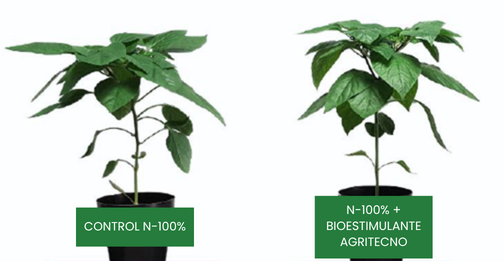
Control: plant on the left; AgriTecno-treated plant on the right.
Conclusions
In an agricultural scenario where sustainability and profitability are priorities, improving NUE is strategic.
AgriTecno biostimulants:
- Increase nitrogen uptake, assimilation, and utilization.
- Enhance photosynthesis and the synthesis of essential compounds.
- Improve productivity even under reduced fertilization.
An effective tool to optimize fertilization, improve yields, and ensure more profitable and sustainable crops.
However, improving NUE does not end at plant physiology: its real value is confirmed when this efficiency translates into field performance. In the next article, we will analyze this agronomic validation.
Ready to reduce fertilizer costs and improve nitrogen efficiency? Discover how AgriTecno biostimulants perform under real field conditions. Contact our technical team.