
Where innovation meets reality
An agricultural solution demonstrates its true value when it leaves the laboratory and faces real-world field conditions.
High temperatures, intense solar radiation, limited water availability, different soil types, and management systems mean that every growing season presents new challenges.
That is why field validation plays a central role at AgriTecno.
We work alongside growers, distributors, and technical teams to evaluate our technologies across different crops and production conditions. The objective is not simply to measure final yield, but to understand how the crop responds, why it responds, and whether that response is sustained through harvest.
From agronomic trials to actionable recommendations
Field validation can take many different forms.
In Spain, AgriTecno programs have been evaluated using ultra-low-volume drone applications. In Cambodia, trials have been conducted directly in rice fields alongside local partners. In peach crops, applications at different developmental stages have been studied to assess their impact on fruit quality and post-harvest performance. In zucchini, different levels of water availability have been compared to evaluate crop response to drought.
We also look at what happens below the surface.
Soil profile pits, for example, allow us to directly examine how different management strategies influence root exploration and the crop’s ability to use the available soil volume.
These are very different scenarios, but the question is always the same:
Can the response we observe translate into a meaningful agronomic benefit for the grower?
Two field trials provide particularly clear examples of how we put this question to the test.
When solar radiation compromises crop quality
High solar radiation and elevated temperatures can become a direct economic challenge.
In apple orchards, sunburn can damage the fruit surface and reduce marketable quality. To evaluate a preventive strategy, SunGuard was compared under field conditions with both an untreated control and a commercial kaolin-based reference.
Up to 4.9°C lower fruit surface temperature
Fruit treated with SunGuard recorded a surface temperature up to 4.9°C lower than the untreated control.
By limiting heat accumulation on the fruit surface, SunGuard helped reduce thermal stress during periods of intense solar radiation. This contributes to limiting the physiological disruptions associated with excessive temperatures and to maintaining greater continuity in fruit growth and development.
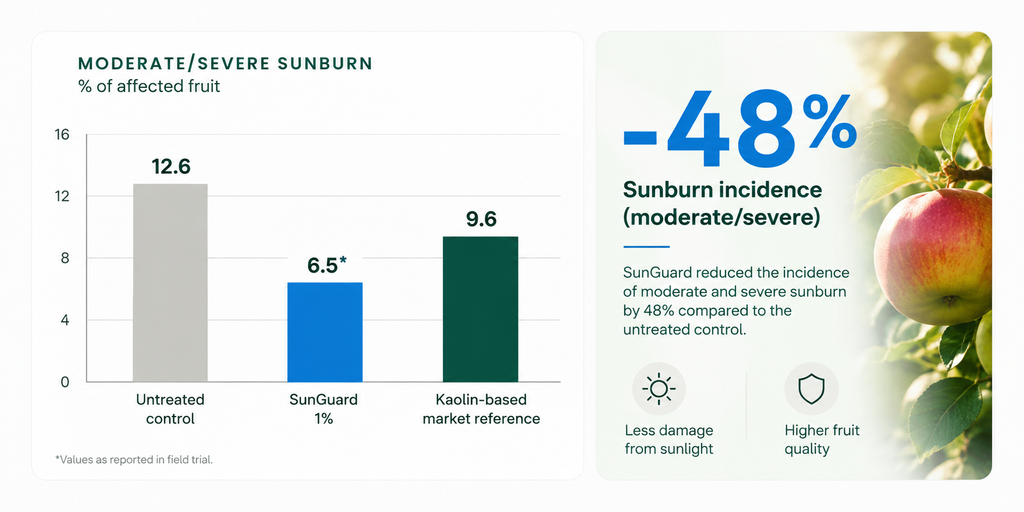
48% less moderate and severe sunburn
This protection was also reflected in less visible heat damage. At the end of the trial, SunGuard reduced the incidence of moderate and severe sunburn by 48% compared with the untreated control, precisely the damage categories with the greatest impact on fruit quality and marketability.
When every drop needs to work harder
Water availability presents a different challenge.
When irrigation volumes decrease, it is not only about how much water the crop receives. What also matters is how water enters the soil, how it is redistributed, and how much remains available within the root zone.
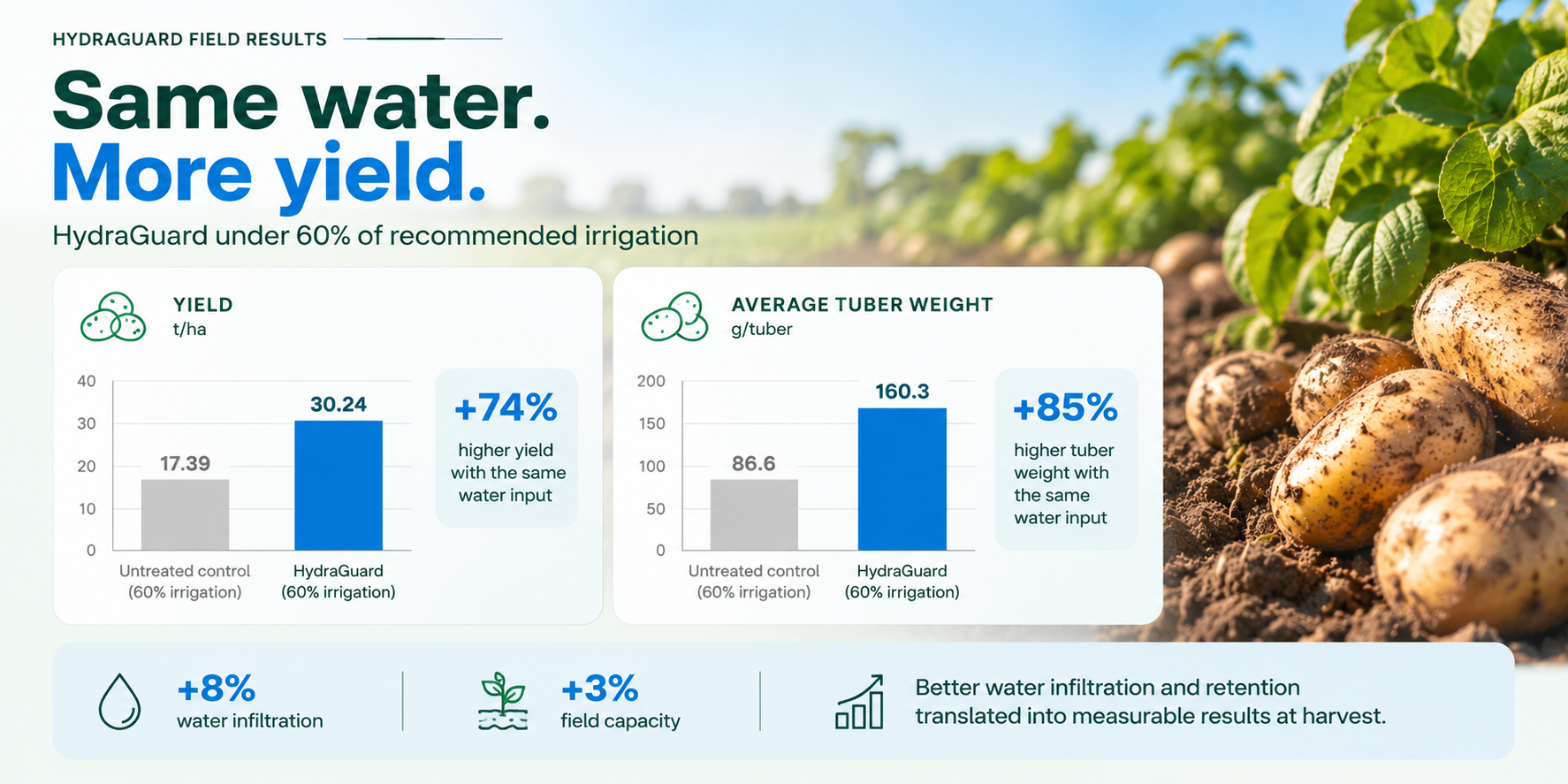
To evaluate this under real-world conditions, HydraGuard was tested on Victorina potatoes.
Throughout the entire crop cycle, the HydraGuard treatment received only 60% of the recommended irrigation and was compared with both an untreated control under the same water deficit and a control receiving 100% irrigation.
What happened to the water in the soil?
Under the same limited irrigation regime, HydraGuard achieved:
+8% infiltration capacity
+3% field capacity
The results showed improvements in both water infiltration and the soil’s capacity to retain water, helping more of the same amount of applied water remain available within the root zone.
But improving a soil parameter only has real agronomic value if that response ultimately reaches the crop.
And that is exactly what happened.
From water management to yield
With only 60% of the recommended irrigation, HydraGuard recovered most of the yield gap, reaching 30.24 t/ha versus 17.39 t/ha in the untreated crop and approaching the 36.24 t/ha achieved with full irrigation.
Validation means understanding what happens through harvest
SunGuard and HydraGuard address different agronomic challenges, but both cases illustrate the same approach.
Validation does not end when we observe an initial response in the plant or soil.
We follow the crop to determine whether that response is sustained and ultimately translates into parameters that matter for crop production and harvest quality.
Because bringing science to the field means exactly that: observing, measuring, comparing, and generating knowledge that can be translated into actionable agronomic decisions.
At AgriTecno, innovation does not end with the development of a technology.
It continues in the field.
Discover AgriTecno solutions and how they can help you address the challenges facing your crops.